Oil Painting Workshops in Warsaw – From Learning About Paints to Creating Your Own Painting
Oil painting offers great freedom when working with color, light, and texture. Oil paint dries more slowly than acrylic, which makes it possible to return to individual parts of a painting, refine tonal transitions, mix colors directly on the canvas, and gradually build up successive layers. Oil painting workshops in Warsaw are an opportunity to explore this technique through hands-on practice rather than simply observing finished paintings or experimenting independently with randomly selected materials.
'
At Art-studia Mara, painting is approached primarily from a practical perspective. Working on a painting allows participants to see how oil paint behaves, how colors interact with one another, and why the order in which different stages are completed matters in this technique.


What does working with oil paints involve?
A first experience with oil painting may be quite different from what someone accustomed to school paints or fast-drying acrylics might expect. Oil paints have a different consistency, remain workable and blendable for a long time, and the way successive layers are applied affects the final appearance of the painting.
While painting, you need to learn not only how to choose colors, but also how to control the amount of paint on the brush, its consistency, and the way each brushstroke is applied. Creating a soft transition between light and shadow requires a different approach from making a clear, deliberate brushstroke.
Observation is another important part of the process. Proportions, relationships between large areas of color, color temperature, and tonal values often have a greater impact on how a painting is perceived than the meticulous reproduction of small details. For this reason, a painting usually develops in stages - from the overall composition to an increasingly deliberate treatment of selected areas.
What can the process of creating a painting during a workshop look like?
The process does not begin with randomly applying colors to the canvas. First, it is necessary to consider the composition and placement of the most important elements. The next step may involve defining the main areas of light and shadow and establishing the basic color relationships.
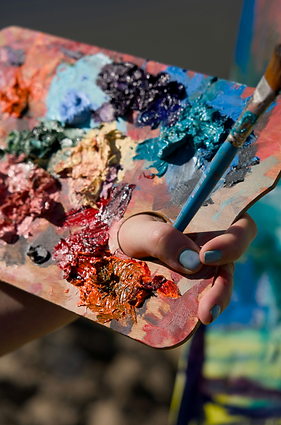
The painting is then developed on this foundation. Participants gradually learn how to mix paints, create colors from several components, and achieve the desired tone without relying exclusively on colors straight from the tube. This is a good opportunity to discover in practice why adding white is not always the best way to lighten a color and how even a small amount of another hue can change the temperature of the entire mixture.
As the work progresses, other aspects come into play: modeling form, working with edges and contrasts, creating texture, and using more precise brushstrokes. Not every part of a painting requires the same level of detail. One of the skills developed through painting is learning to recognize where precision is necessary and where a freer, more expressive area of color produces a better effect.
During studio classes, participants can go through this process with guidance from the instructor. This support is particularly useful when it is difficult to determine why a color has become too gray, why a form looks flat, or why further corrections are beginning to make an earlier result worse.

Do you need to know how to paint before your first workshop?
A lack of previous experience does not mean that you cannot begin learning oil painting. At the start, understanding the basics of working with the materials and learning to see a painting as a combination of shapes, tonal values, and colors is more important than having extensive theoretical knowledge.
For beginners, mixing colors can be one of the main challenges. A color seen in a photograph or on the object being painted rarely corresponds to a single ready-made paint color. You need to learn to assess whether it is warmer, cooler, lighter, darker, or less saturated. These relationships become much easier to understand when you actually mix paints on a palette.
Another challenge is the tendency to move on to details too quickly. Carefully rendered details cannot fix a painting if the proportions, large shapes, and contrasts have not been established correctly beforehand. Guidance received while working helps identify such problems at a stage when it is still easy to change the direction of the painting.
What makes oil painting distinctive?
One of the most characteristic features of oil paints is their long drying time. For beginners, this may initially seem inconvenient, but it also makes it possible to work on a painting at a more relaxed pace. Colors can be blended directly on the surface, transitions can be softened, some of the paint can be removed, and selected areas can be corrected.
The technique also allows for different ways of working - from thin layers to more pronounced paint textures. Over time, you can consciously decide whether the surface should remain soft and subtle or whether visible brushstrokes should become an important part of the painting.
Direct contact with the material is the best way to understand these properties. Reading about color mixing or layering provides a useful foundation, but only through painting can you learn how much paint to load onto the brush, when to stop blending two colors, and how a single brushstroke can change the surrounding area of the painting.


Oil painting as a practical way to develop observation skills
Workshops do not have to be limited to creating a painting according to a predefined formula. Working with paint can also be an exercise in decision-making: which color to prepare, which area to simplify, where to increase contrast, and where to leave a softer transition.
At Art-studia Mara, learning artistic techniques is combined with practical work on your own project. In the case of oil painting, this means experiencing the properties of the medium directly at the easel and gradually becoming familiar with a process that may initially seem more complex.
If you are interested in oil painting workshops in Warsaw, the next step may be to check the latest information about classes at the Mara studio. This will help you choose a format that suits you - whether you want to try oil paints for the first time or develop skills gained through previous painting experience.