How Creativity Develops Through Regular Watercolor Classes
Updated: Aug 29
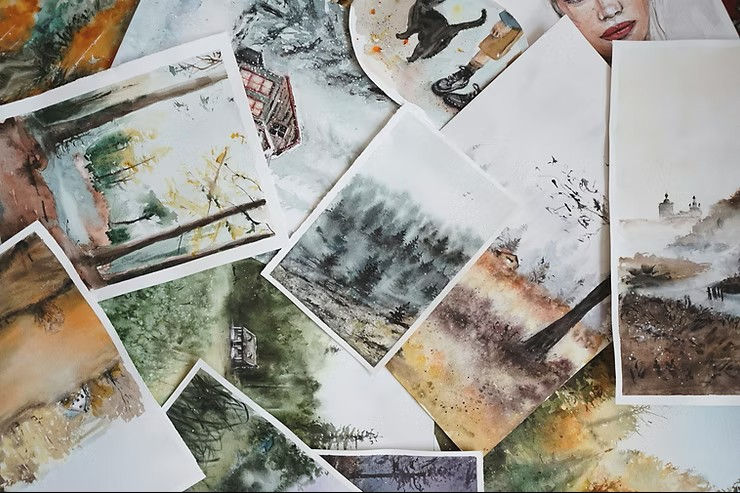
People who begin a watercolor course usually focus primarily on learning the technique. They wonder how to mix colors correctly, control the amount of water, or paint light effectively. Over time, however, they discover that regular classes develop far more than technical skills. Their way of observing the world, making creative decisions, and finding personal artistic solutions gradually changes as well.
It is through this process that creativity steadily develops. Those who want to learn under the guidance of experienced instructors often choose a watercolor course, which allows them to build their skills step by step while consistently improving their artistic practice.
This transformation does not happen overnight, nor is it the result of a single exercise. Creativity develops through consistent practice, accumulated experience, and increasing confidence in working with the medium.

Why Does Watercolor Encourage Creative Thinking?
Watercolor is a medium that naturally leaves room for unpredictability. Water affects the movement of pigment, colors blend in unexpected ways, and every painting develops a little differently. For beginners, this can be frustrating, but over time it becomes one of watercolor’s greatest strengths.
During classes, students learn that not everything has to be completely controlled. Instead of fighting every unexpected effect, they begin to embrace the natural characteristics of the paint. This approach encourages flexible thinking and teaches artists to respond to what happens on the paper.
This is a valuable skill beyond the studio as well. It becomes easier to explore different solutions instead of holding rigidly to a single predetermined plan.

Consistency Brings Better Results Than Occasional Inspiration
Many people believe that creativity is something you are either born with or not. However, watercolor courses clearly demonstrate that creativity grows through consistent practice.
Regular classes allow students to:
become comfortable with the materials instead of focusing only on technique,
recognize the relationships between color, light, and composition more quickly,
make bolder artistic decisions,
experiment without fearing every mistake.
At first, most of a student's energy is spent simply completing the exercise. As the fundamental techniques become more natural, there is more room for consciously developing a personal style and exploring original ideas.
This is why people who attend classes for several months often notice changes not only in the quality of their artwork but also in the way they think about the creative process itself.

Observing the World Becomes More Mindful
One of the less obvious benefits of learning watercolor is the development of observation skills.
Instructors encourage students to look beyond the object itself and pay attention to relationships between colors, the direction of light, color temperature, and proportions. Over time, this way of seeing naturally extends beyond the classroom.
A walk through a park, city architecture, or everyday objects become sources of inspiration for future paintings. People studying watercolor begin noticing details that previously went unnoticed.
This heightened awareness is an essential part of creativity. New ideas do not come solely from imagination-they often arise from the ability to truly notice the world that already surrounds us.
Why Are Mistakes an Important Part of Learning?
Beginners often try to create a perfect painting on their very first attempt. Watercolor quickly teaches them that this expectation is unrealistic.
Uneven tonal transitions, colors that become too dark, or using too much water are not failures. Instead, they provide valuable information about how the paint behaves and what can be improved in the next attempt.
With regular practice, students gradually change their attitude toward mistakes. Instead of avoiding them at all costs, they learn to analyze what happened and search for better solutions. As a result, their confidence grows, and creativity is no longer limited by the fear of making errors.

How Does Decision-Making Change During the Painting Process?
At the beginning of a course, most students ask questions about nearly every stage of their work. Which color should I choose? Where should I begin? Is this section correct?
After some time, these questions become much less frequent.
This is not because students know every answer, but because they begin analyzing situations independently and making their own artistic decisions.
This marks an important stage of creative development. Creativity is not only about generating new ideas. It is also the ability to consciously choose among many possible solutions.
Regular practice provides the experience needed to experiment with greater confidence instead of constantly searching for a single "correct" way to complete a painting.

Everyone Develops Creativity at Their Own Pace
One of the most common questions at the beginning of a watercolor course is when noticeable progress will appear. There is no universal answer.
Some students quickly become confident experimenting with color, while others need more time to feel comfortable with the technique itself. This is completely natural. Creativity does not develop according to a fixed timeline, and comparing one person's progress with another's is rarely meaningful.
What matters most is consistency and a willingness to keep trying. Even short but regular practice sessions produce better long-term results than occasional marathon painting sessions.
After several months of learning, many students notice that painting is no longer simply about reproducing reality. It becomes a way to express personal ideas, emotions, and an individual perspective on the world.
This is perhaps the clearest demonstration of how regular watercolor classes foster creativity-not through sudden inspiration, but through the gradual development of confidence, awareness, and artistic freedom.